
A couple of months ago, I checked out two books on weaving from my local library. I was inspired by the lovely items a good friend of mine created and gifted to me over the past couple of years. I’m well-seasoned in the crafts of crochet and sewing and have boxes of fabric and yarn scraps already. It seemed weaving would not only use what I already have, but also be calming, meditative even. It’s essentially a craft that requires you to pull a fiber through a fixed set of threads, over under, over under, until done. The first couple of projects I completed were predictably misshapen, with a missed stitch here or there.
“What are you making?” my husband asked from over my shoulder, observing my first attempt.
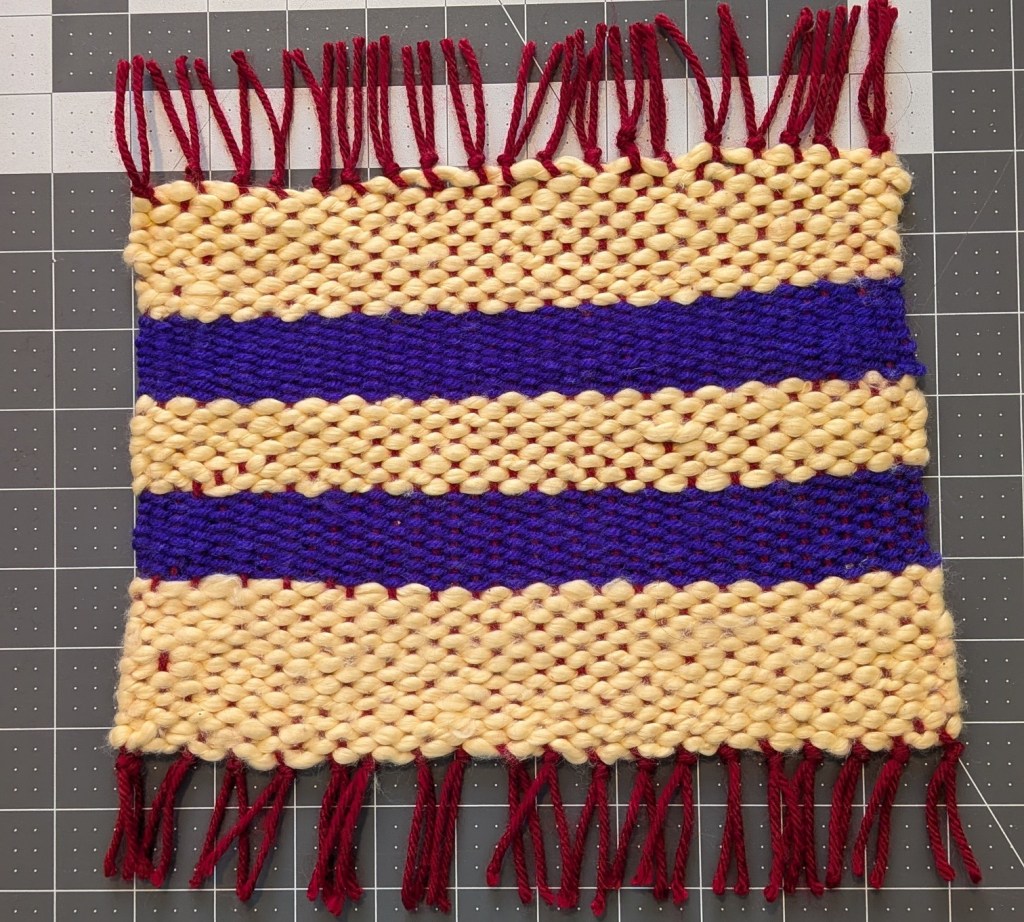
“Nothing. Just practicing.” I created a striped rectangle with fringe. Isn’t that enough?
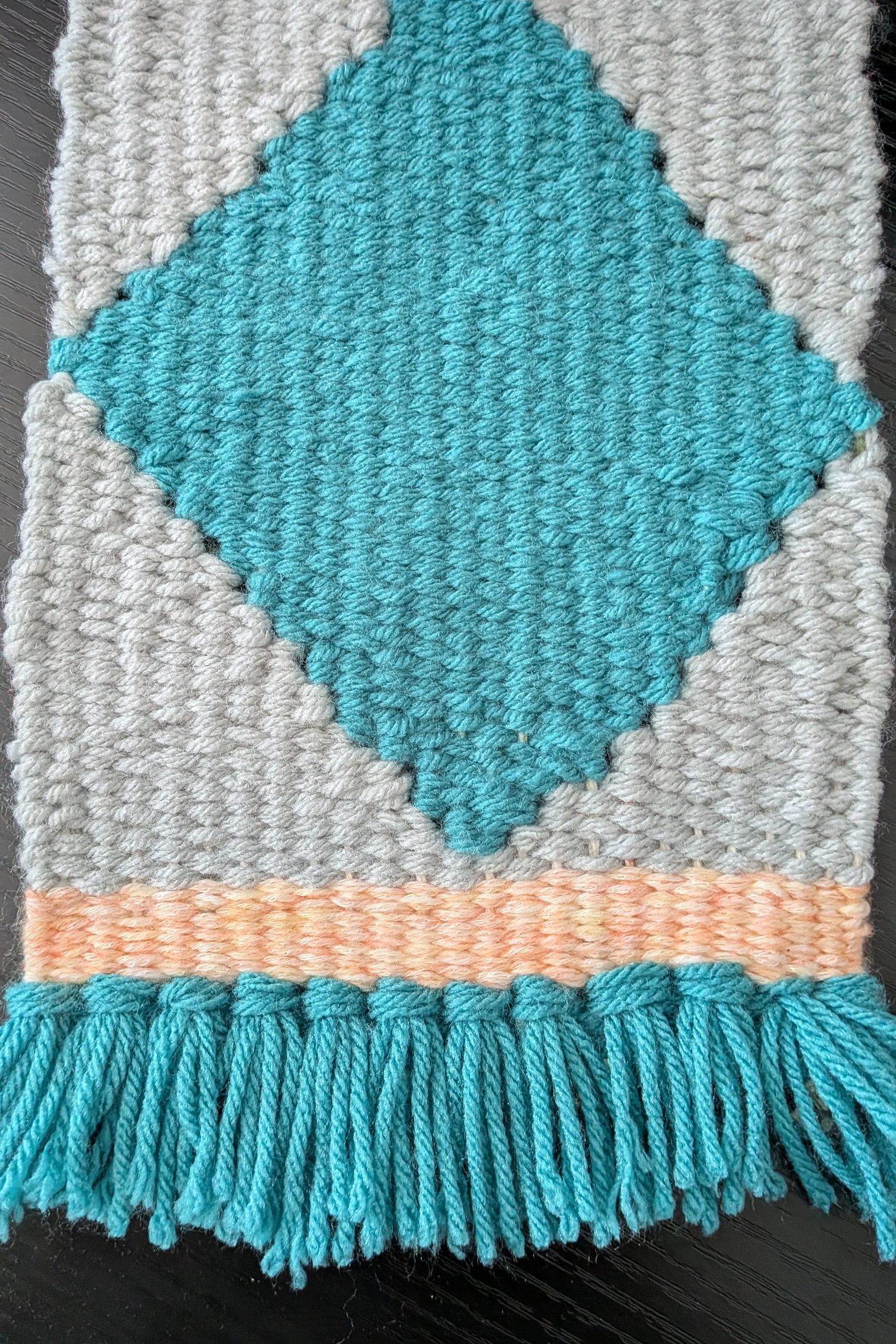
My second attempt was more challenging: a diamond shape in teal woven against a field of gray, with a peach stripe and teal fringe. It involved what’s called a “tabby” weave with double strands of yarn, giving an interesting texture to the product. But the diamond is off-center. I should have begun with an even number of warp threads, (the stationary threads you weave around), which the instructions didn’t mention. There were yarn tails everywhere that I had to weave (clumsily) into the back side. However, the exercises taught me a lot.
Learning to weave reminds me of every new skill I’ve learned in life, including writing. In every case, there’s a lot of practice involved, one of the best methods of improving any craft. Some of the best lessons I’ve learned have been through failure. Failing to check the over-under pattern at the end of each woven row or failing to articulate a concept with the clearest words are opportunities to improve a skill.
Someone asked me recently if I’d always wanted to be a writer. It’s a good question, because my first book wasn’t published until I was 70 years old, a late start for a book author. I almost answered that it took me this long to learn good writing skills, but that’s not entirely true. Truthfully, I’ve been practicing most of my life. What I most needed was time.
The urge to write goes back to my teenage years. I dreamed of being a writer when I was in high school. Remember those ads in the back of magazines that had you send a short sample of writing off to a company who—SURPRISE!—found your writing sample profound? They were willing to offer you a place in their writing school for the low, low price of … Yeah. I did that. But I didn’t have the resources to enroll in their classes. Instead, I made the most of my high school and college English classes to practice putting words on paper.
I attempted to make a go of a writing career in my forties without success, then took time off for a job with a steady paycheck and health insurance: teaching high school and community college. This involved another dozen-plus years of learning and practicing new skills, during which I wasn’t writing, unless you count lesson plans. After retiring, I returned to a memoir I’d begun 15 years earlier. Eventually, this became my first published book. Three years later, I’m about to embark on book number five.
After all these years, it’s difficult to know where I picked up this or that wisdom about writing. I’ve taken literally dozens of writing classes, learning a little in each one. Some of them simply reinforced what I already knew, which is also valuable. The constant with each of them was that I practiced. I wrote. I rewrote. Then I revised what I wrote. Every word, every sentence, just like a row of woven fabric, gives me a chance to create something new. Each one may be imperfect, but each has the potential to be stunning if I keep at it.
Yesterday, I took a class in basic weaving at Pioneer Farms in Austin, which is a small village of vintage farmhouses and other buildings moved from a nearby historic town named Sprinkle, Texas. No kidding—it was named for a cowboy named Erasmus Sprinkle in the 1870s. The town still existed in 1990 but with almost no residents. There are more Sprinkle structures at Pioneer Farms than are left in Sprinkle itself.
Our instructor, Janet, was an older woman, maybe even older than me. She said she’d mostly taught herself to weave. She showed us a half dozen different styles of looms and helped us each get started with a small cardboard loom and assortment of yarn that we could take home. Janet also shared some history of various spinning and weaving crafts while we worked. Over under, over under.
I realized after the first hour that I’d already learned a lot of basics through my limited practice, but I also have a long way to go to produce anything like the lovely jacket and scarves Janet had woven and brought to show us. I just hope it doesn’t take me as long to create a wall hanging or place mat as it did to create a publishable memoir!
I’m not sure I’ve ever believed that practice makes perfect, but in the case of weaving, as with writing, practice can certainly make beautiful.
 Janice Airhart