
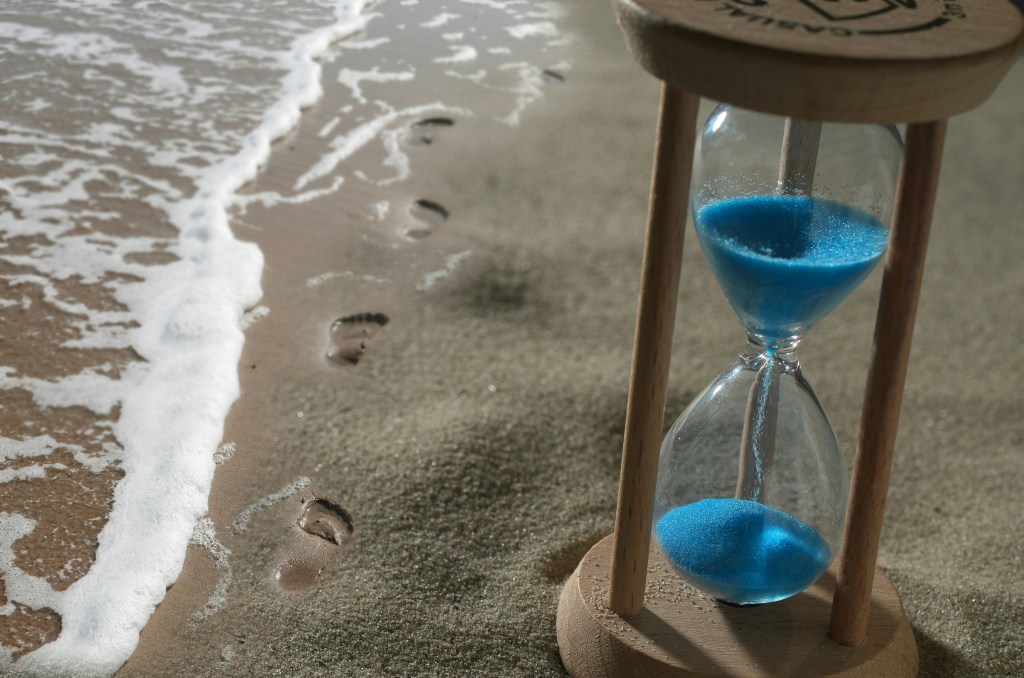
When I was in eighth grade, near the end of what I remember as last period earth science class, the clock hands slowed down to the pace of sedimentary rock formation. This was when clocks still had hands, of course. Absurdly, those hands sped up during our lunch break and when I tried to squeeze in a conversation with a friend between classes. Fortunately, the halls at Oak Park Junior High weren’t all that long. I could usually still slide into my chair before second bell.
When I taught eighth grade science—and all the grades above that—I had a similar time perception problem. Minutes slowed most during lecture periods and speeded up during complex laboratory experiments. I didn’t much care for lecturing in the first place, so I minimized it in favor of labs. Hands-on activities appealed to me and engaged students more anyway. But I invariably underestimated the time it took to set up the ring stand clamps, mass out and boil the mixture of solids and liquids, and scrub the residue from beakers and flasks afterwards. As a result, I was too often left with cleanup duty.
Unfortunately, a certain amount of lecture was necessary to introduce science units, but predicting accurately how much time it would take was difficult. While I could plan a short video and a ten-minute lecture overview of energy pyramids in environmental science, for instance, students might respond with a lot of questions that required detailed explanations. Drawing graphs on the board, displaying a chart or illustration from the web, and so on. We often ran over our allotted time. On the other hand, students would sometimes nod their heads occasionally throughout the lecture, answer my comprehension questions well, and ask for no more details. We’d dig right into our planned activity or lab ahead of schedule, which sometimes (shockingly) went as planned, leaving extra time. It was then that my principal’s words would echo in my head: “Engage them bell to bell, Mrs. Airhart. Bell to bell.”
One of the teacher maxims I heard before stepping into the classroom for the first time was this: Always plan more material than you think you’ll need. It didn’t take long—maybe the first week of school—to discover the value of this statement. I work best when I have time to consider my options. It soon became apparent that if I didn’t want to spend the last ten or fifteen minutes of a class period awkwardly rephrasing what I’d already said or struggling to locate one more brief video to project on the Smart Board, I’d have to do my thinking in advance.
Lesson planning appealed to my sense of organization and need to control my environment, and I was a master at it. I still have thousands of lesson plans, quizzes, and lab procedures saved on my laptop’s hard drive, a treasure trove of memory. They total more than 24,000 individual files, though some of those are images or activities copied from the CDs provided by our textbook publishers. While working on my memoir, Subject to Change: What Teaching Teen Moms Taught Me, I’d randomly consult a lesson plan on population pyramids or the strawberry DNA extraction lab for a chapter I was writing.
My cache of files is a testament to how well I learned to plan more than I needed for every unit I taught, over eight years, in as many as eight courses at a time. All that planning took time. To be precise, it took most of every weekend. Planning time seemed to incinerate as quickly as pure sodium in the presence of oxygen. However, to know on Monday that I could fill class time all the way through Friday was worth the effort. I was more flexible with letting go what wasn’t essential than I was at killing time.
Today’s eighth grade students don’t have any more patience than I did with a stuttering teacher who has too much time on her hands. My science classroom had an analog clock on the wall (an atomic clock with guaranteed accuracy) but students didn’t know how to read it. It was there more for my benefit than theirs. Instead of watching the second hand tick around its face with agonizing slowness, they glanced at their phones every millisecond to see if the time had changed. I expect time dragged on during earth science for them, just as it did for me. The least I could do was make the most of our time together by adding layers of solid bedrock, no matter how thin, to their educational experience.
I’d like to know: When does time seem to slow down for you? When does it speed up? Drop your answer in the comments.
 Janice Airhart